


What Size Rug Goes Under a Queen Bed? Exact Bedroom Placement Guide

What Size Rug Goes Under a Queen Bed? Exact Bedroom Placement Guide
The right rug for a queen bed depends on how much floor you want covered and where the bed sits in the room. A 5×8 rug can work in a tighter bedroom, while 8×10 gives you much more coverage. The important part is matching the rug to the bed, nightstands and available walking space.
Wayfair’s current queen-bed rug guide lists several workable sizes and notes that bedroom placement often works best when the rug extends beyond the bed rather than stopping exactly at its edges.
Feed Flow’s queen-bed-in-an-8×10-room guide is useful if the room itself is tight. If you are working with a king bed, see the 10×12 king-bed layout guide.
Start With the Queen Bed Measurements
A standard queen mattress is about 60 inches wide by 80 inches long. The actual bed frame is often larger, so measure the frame rather than planning around the mattress alone.
Then measure the room from wall to wall and mark the location of doors, closets and other furniture. A rug can be large enough for the bed and still be wrong for the room if it blocks a door or makes a main walkway too narrow.
Best Rug Sizes for a Queen Bed
| Rug size | Best use | Coverage |
|---|---|---|
| 5×8 | Smaller bedrooms | Works well under the lower portion of the bed |
| 6×9 | Medium rooms | More side and foot coverage |
| 7×9 | More generous coverage | Can frame the bed and provide substantial side space |
| 8×10 | Most flexible full-looking layout | Good for the bed plus more surrounding floor |
| 9×12 | Large bedrooms | Broad coverage and room for larger furniture groupings |
There is no rule that says a queen bed requires one specific rug size. The room and desired placement decide the final choice.
Choose the Placement First
Option 1: Rug Under the Bottom Two-Thirds
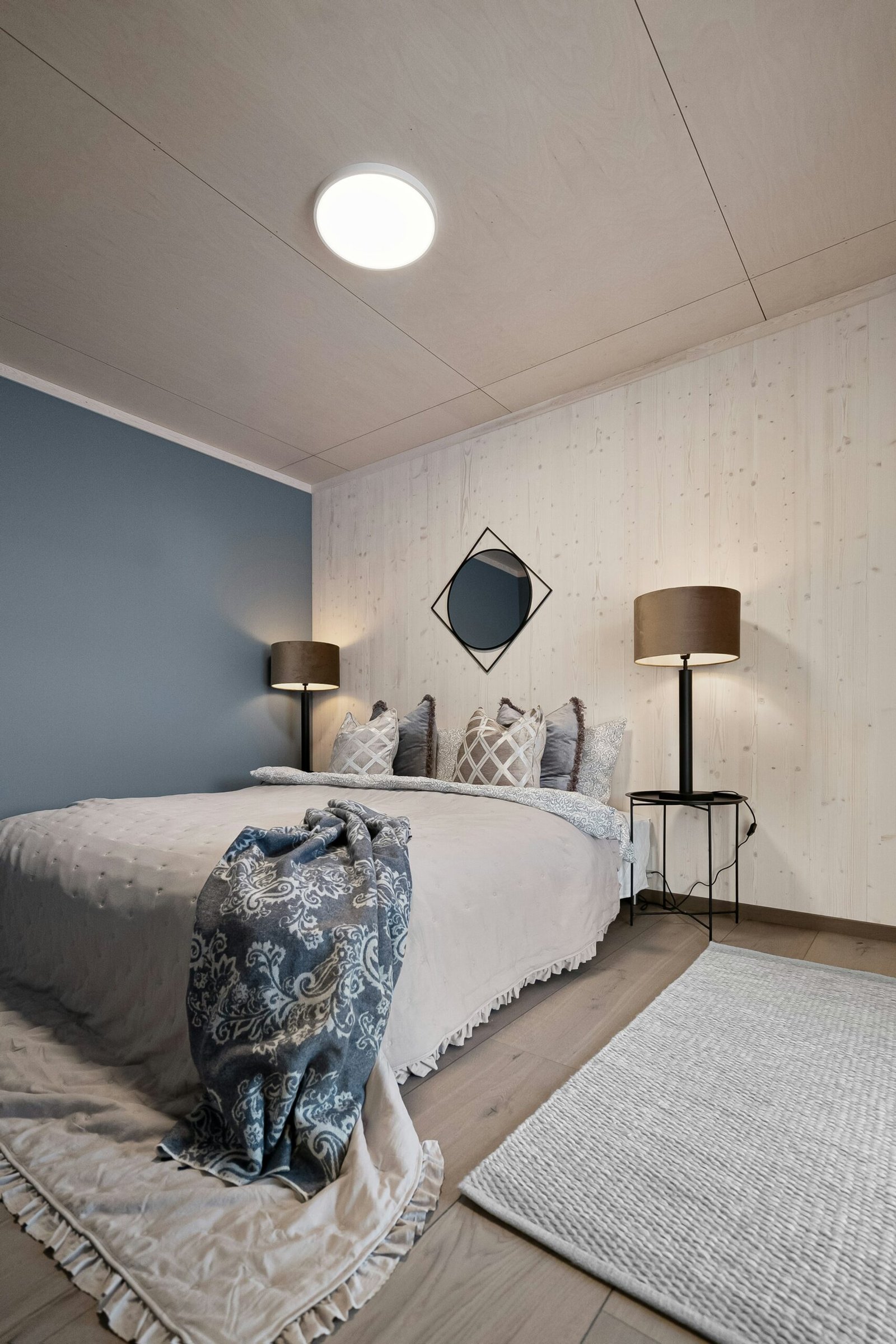
For many bedrooms, the practical starting point is to place the rug under the lower portion of the bed. The head of the rug sits below the nightstands while the rug extends out toward the foot and sides.
This can work well when an 8×10 would be too large or when you want the rug to soften the area where you step out of bed.
Option 2: Rug Under the Bed and Nightstands
A larger rug can extend far enough to include the nightstands. This creates a single visual zone around the bed, but it requires more floor area.
An 8×10 is often a useful starting point for this style. Measure the entire furniture group before buying rather than assuming the standard size will fit.
Option 3: Full Bed Coverage
For a large bedroom, an 8×10 or 9×12 can place more of the bed and surrounding furniture on the rug. This works best when you have enough floor around the group to keep the room from feeling crowded.
Small Bedroom Options
If the bedroom is small, do not force a large rug into the room just because it looks better in a catalog photo.
A 5×8 rug can be useful under the lower portion of a queen bed. If the room has two clear sides of the bed, a pair of runners can also provide soft landing areas without taking over the floor.
Leave the door swing and primary walking path clear. Feed Flow’s small-bedroom guide covers the same principle from a room-layout perspective.
Should the Rug Go Under the Nightstands?
It can, but it does not have to.
If the rug stops below the nightstands, the room can still look intentional. If you want the nightstands on the rug, choose a size that extends beyond the entire bed-and-nightstand group.
The important measurement is the total width. Measure from the outside edge of one nightstand to the outside edge of the other, then add enough rug on each side to create the look you want.
When Runners Make More Sense
Runners are useful when:
- The bedroom is too small for a large area rug.
- The bed is against a wall on one side.
- You mainly want softness beside the bed.
- You do not want to move a heavy bed to place a large rug.
Keep the runners aligned with the bed and avoid letting them project far into the main walking path.
Keep Walkways Clear
Rug size should never be decided without looking at circulation. Measure the distance between the rug edge and the doorway, closet, dresser and other routes you use every day.
A rug that technically fits can still make a room awkward if you have to step around its corners to reach the closet.
Wayfair recommends keeping main walkways clear and suggests roughly 18 to 24 inches of rug beyond the bed for several common bedroom layouts.
Use a Simple Sizing Formula
For a queen bed, start with the bed width of 60 inches. Then decide how much rug should extend beyond each side.
For example, if you want about 24 inches of rug visible on both sides of the mattress, the visible width would be roughly:
60 + 24 + 24 = 108 inches
That is 9 feet of width before you account for the exact frame, nightstands or desired placement. This is why an 8×10 can work for one room while a 9×12 is more comfortable in another.
Common Sizing Mistakes
- Buying for the mattress only: the frame and furniture group are usually larger.
- Ignoring the door: a rug can interfere with a door swing.
- Choosing by room size alone: furniture placement matters just as much.
- Using a tiny rug: a small rectangle floating at the foot of a large bed can look disconnected.
- Skipping a floor plan: tape the intended rug dimensions on the floor before ordering.
A simple painter’s-tape outline can save you from buying and returning a rug that looked right online but feels wrong in the room.
Feed Flow’s Take
For most queen bedrooms, start by comparing 5×8, 6×9, 8×10 and 9×12 rather than assuming one size is universal. Measure the bed frame, nightstands and walking paths, then choose the placement that fits the way the room is actually used.