
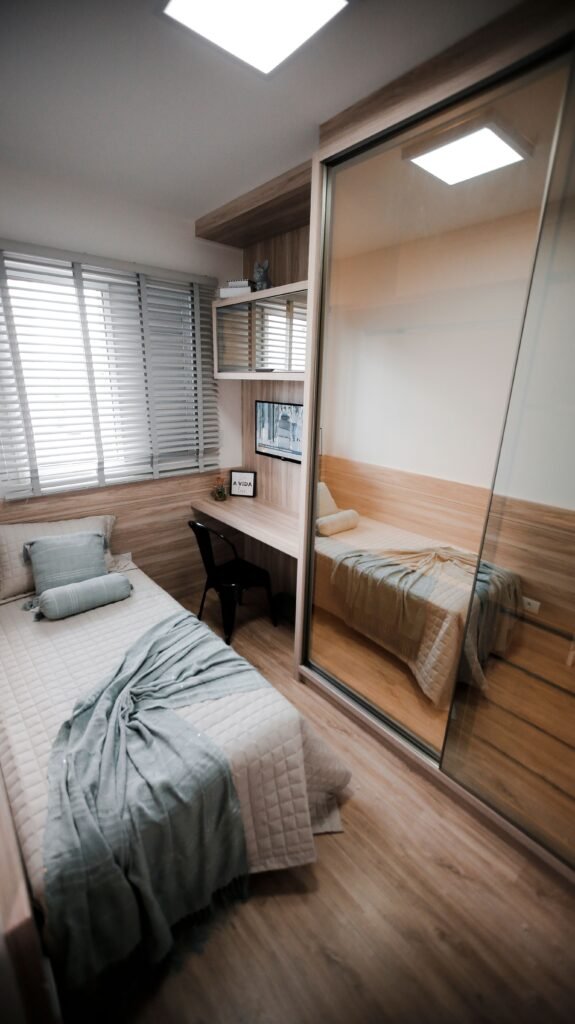
A small bedroom does not need a renovation to feel noticeably more open. The biggest changes usually come from what the eye sees first: visible floor, furniture scale, window treatment, lighting, and clutter.
You also do not need to buy a room full of new decor. In many bedrooms, rearranging what you already own will make a bigger difference than adding another storage unit.
Start With the Floor
Look at the route from the door to the bed, closet, bathroom, or window. Keep that path as clear as possible. If you have a chair that is rarely used, a large hamper, or a decorative table taking up valuable floor area, test the room without it.
Every piece of furniture should either support a daily routine or provide storage you actually need. Feed Flow’s 21 small bedroom ideas that look expensive covers the broader styling side; this guide focuses on making the room feel larger.
1. Make the Bed the Anchor
The bed is normally the largest visual object in the room. Position it so the main walking path remains open, then arrange smaller pieces around it. Do not force symmetry if symmetry makes the room harder to use.
2. Simplify the Largest Visual Areas
A simple duvet or comforter in one main color creates a calmer block than several competing patterns. Add texture through one or two pillows or a throw rather than layering every pattern you own.
3. Use One Well-Placed Mirror
A mirror can reflect light and create the impression of additional depth. Place it where it reflects a window, bright wall, or open section of the room. Avoid reflecting clutter because the mirror will visually repeat it.
4. Take Curtains Higher
If the window and wall allow it, mount the curtain rod higher and let panels fall close to the floor. This draws the eye upward and makes the wall feel taller. A simple fabric usually works better than a busy pattern in a compact bedroom.
5. Keep the Window Area Clear
Natural light makes a room feel more open. Avoid placing tall furniture directly in front of the window when you have another option. Open curtains during the day and use a lighter privacy treatment if you need one.
6. Use Vertical Storage
When floor space is limited, look upward. Floating shelves, tall narrow storage, hooks, and wall-mounted organizers can move belongings away from the floor. But vertical storage should solve a real problem rather than become another place for clutter.
7. Keep Storage Visually Quiet
Large storage furniture becomes less dominant when it blends with the wall behind it. You can also reduce the number of objects sitting on top of dressers and cabinets. Fewer competing shapes make the room easier for the eye to read.
8. Limit the Color Palette
A small bedroom can have color. The problem is usually too many unrelated colors. Try a base, a secondary color, and one accent. For example, warm white + beige + muted green or cream + brown + dusty blue.
9. Clear the Tops of Furniture
A crowded dresser can make the entire room feel crowded even when the floor is clean. Keep daily essentials accessible, but give major surfaces some empty space. A tray can group small objects without making them look scattered.
10. Shrink the Nightstand, Not the Routine
Measure what you actually keep beside the bed. If a large nightstand only holds a phone, charger, book, and lamp, a narrower table or wall shelf may provide the same function with less visual weight.
11. Layer the Lighting
A single bright ceiling light can make a small room feel flat. Where possible, combine overhead lighting with a bedside lamp or wall light. Distributed warm light gives corners more depth.
12. Keep Some Floor Visible
A rug can make a bedroom warmer, but the wrong size can visually chop up the floor. Measure before buying and make sure the rug works with the furniture arrangement.
13. Organize by Frequency of Use
Keep everyday clothes and items within easy reach. Move seasonal clothing, spare bedding, and occasional-use belongings into higher, deeper, or under-bed storage. Feed Flow’s Ultimate Small-Space Home Guide covers this principle across bedrooms and other rooms.
14. Hide Cables
Charging cables create visual lines that make surfaces look messy. Use clips or a small charging station around the bed and desk. Feed Flow’s $150 minimalist work-from-home setup for a 10×10 room has more small-room cable and workspace ideas.
15. Leave Some Corners Empty
An empty corner is not wasted space if it makes circulation easier. Before adding a plant stand, chair, basket, or shelf, ask what problem it solves. If the answer is none, leave it open.
A 30-Minute Small Bedroom Reset
- Clear the floor.
- Make the bed.
- Clear the nightstand and dresser.
- Open the curtains and clear the window area.
- Hide visible cables.
- Move one piece of furniture if it blocks the main walkway.
- Put seasonal items into hidden storage.
- Reassess before buying anything.
That last step matters. You may discover that the room needed editing rather than more products.
Mistakes That Make Small Bedrooms Feel Smaller
Oversized furniture, excessive wall storage, too many accent colors, crowded surfaces, and storage bought without measuring are common problems. A product that looks compact online can still overwhelm a small room.
Measure width, depth, height, door clearance, and walking space before ordering furniture.
FAQ
What color makes a small bedroom look bigger?
Light colors can make a room feel open, but an all-white room is not required. A consistent palette and limited visual clutter can work just as well.
Does a mirror really make a small room look bigger?
It can create more visual depth by reflecting light and part of the room. Placement matters more than quantity.
Should a small bedroom have a rug?
Yes, if the size and placement work with the furniture. A very small rug surrounded by furniture can make the floor feel more fragmented.
Final Take
Making a small bedroom feel bigger is mostly an exercise in editing. Clear the floor, simplify the largest visual areas, use light and vertical space intelligently, and make every piece of furniture earn its place. Do those things before spending money.
Further Reading
For additional small-bedroom planning and storage inspiration, IKEA’s bedroom tips and ideas covers space planning, storage, styling, and lighting.
Related Feed Flow Guides
For more practical ideas, read this related Feed Flow guide and this companion article.
Further reading: https://www.architecturaldigest.com/story/how-to-make-a-small-room-look-bigger