

Aesthetic & Minimalist: A $150 Work-From-Home Setup for a 10×10 Room
Living and working inside the same 10×10 room can feel like you’re constantly fighting for space. One corner becomes your office, another becomes your sleeping area, and before long every surface starts collecting cables, notebooks, chargers, and random clutter. Even when the room is technically clean, it can still feel visually overwhelming because too many functions are competing inside only 100 square feet.
For more room-by-room ideas, the Small-Space Home Guide covers layouts, storage and decorating decisions.
For more room-by-room ideas, the Small-Space Home Guide covers layouts, storage and decorating decisions.
For more room-by-room ideas, the Small-Space Home Guide covers layouts, storage and decorating decisions.
What makes the challenge even harder is that most budget workspace advice focuses entirely on productivity while ignoring aesthetics. On the other hand, many Pinterest-perfect setups prioritize appearance but cost hundreds or even thousands of dollars. The sweet spot sits somewhere in the middle: a workspace that looks calm, modern, and intentional while still being affordable and practical for everyday work.
The good news is that you don’t need a dedicated office or a huge renovation budget. Consumer Financial Protection Bureau With smart furniture placement, strict visual discipline, and a realistic budget of $150, you can create an aesthetic minimalist desk setup for a small room that feels significantly more expensive than it actually is.
The Fast Answer: How to Build a $150 Minimalist Work-From-Home Setup
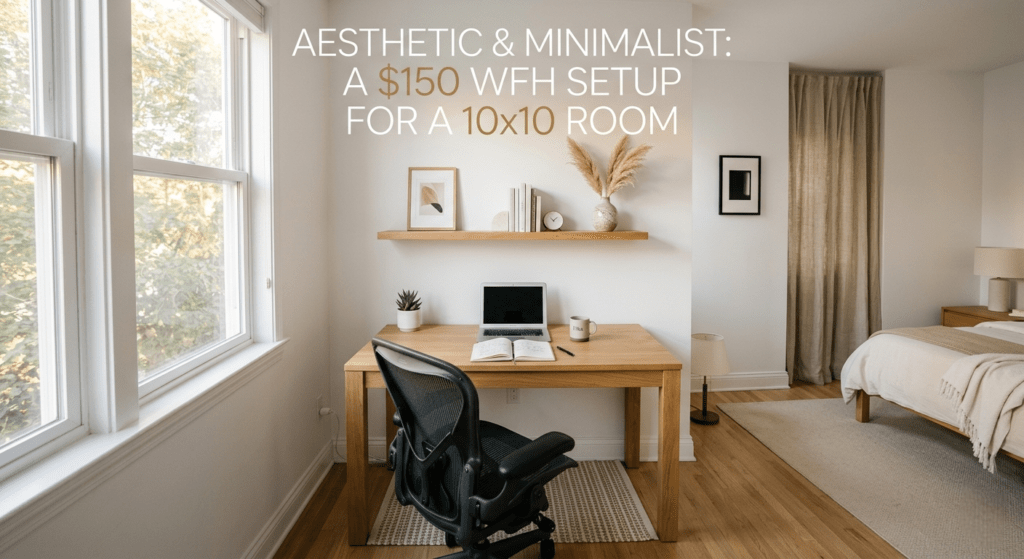
The best aesthetic minimalist desk setup for a small room under $150 consists of three core components: a compact light wood or white desk for around $60, an ergonomic mesh chair for approximately $50, and the remaining budget allocated to cable management, lighting, and subtle decor. The goal isn’t to fill the room with furniture. It’s to remove distractions and create a workspace that supports focus.
When working with a 10×10 bedroom layout with a desk, layout decisions matter more than product choices. A modest desk positioned correctly will outperform an expensive setup squeezed into the wrong location. By separating your work zone from your sleeping zone, hiding visible cables, and maintaining a limited color palette, even the smallest room can feel clean, organized, and surprisingly premium.
This approach works because it prioritizes function first. Every item in the room must earn its place. If something doesn’t improve productivity, organization, or comfort, it probably doesn’t belong in a minimalist workspace.
The Layout Blueprint: Placing a Desk in a 10×10 Room
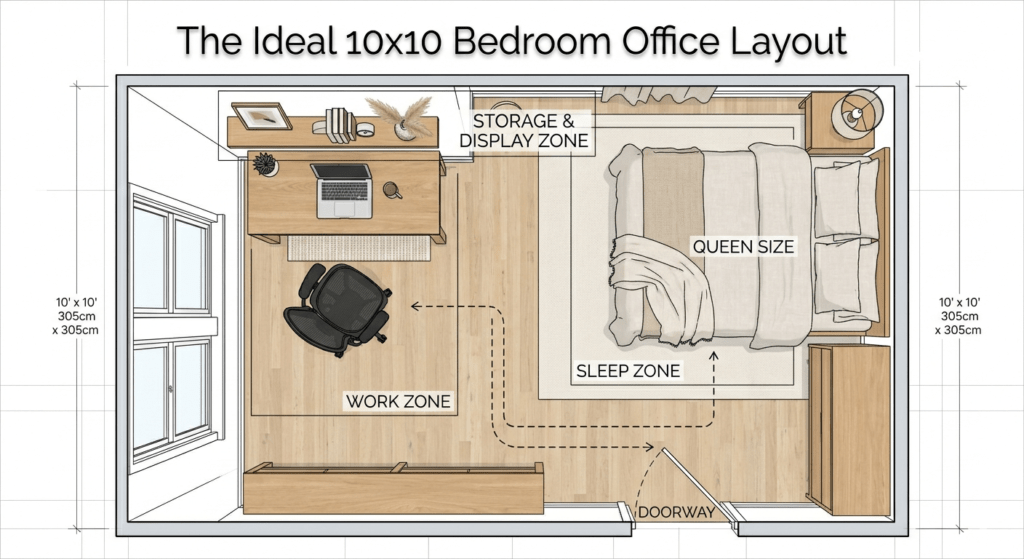
A standard 10×10 room provides exactly 100 square feet of space. That may sound manageable on paper, but once you add a bed, storage, and daily essentials, available floor space disappears quickly. That’s why layout becomes the foundation of every successful small bedroom office.
The biggest mistake people make is treating the desk as an afterthought. They arrange the bedroom first and then squeeze a workspace into whatever corner remains. Unfortunately, that almost always results in awkward walking paths, poor lighting, and a room that feels cluttered no matter how organized it is.
The most effective strategy starts with bed placement. Push the bed fully into a corner or against the longest uninterrupted wall. This immediately frees another wall for a dedicated workspace and creates visual separation between work and rest. Even though both activities happen inside the same room, creating distinct zones helps your brain switch more effectively between productivity and relaxation.
If you’re planning a dual-purpose room, our guide on how to fit a desk and queen bed in a 10×10 bedroom explores additional furniture placement strategies that maximize floor space while maintaining comfort.
Whenever possible, position your desk so that you face a wall instead of your bed. This simple adjustment provides several advantages. First, it minimizes distractions while working. Second, it creates a cleaner video-call background. Third, it reinforces the psychological separation between your workspace and your sleeping area.
Natural light should also influence your layout. Positioning the desk near a window reduces eye strain during the day and improves the overall feel of the workspace. A desk illuminated by natural light almost always appears more inviting than one pushed into a dark corner.
Ideal 10×10 Bedroom Layout Constraints
- Keep at least 24 inches of walking space beside the bed.
- Choose a desk width between 35 and 47 inches.
- Keep desk depth between 18 and 24 inches.
- Maintain 18–24 inches behind the chair.
- Plan for a bed width between 38 and 60 inches.
- Avoid bulky drawer units beneath the desk.
- Use a single uninterrupted wall for the desk whenever possible.
- Install floating shelves above the workspace instead of floor cabinets.
- Position the desk near outlets to reduce visible cable runs.
These measurements might seem small, but they’re what separate a cramped room from a functional one. In compact spaces, a few inches can dramatically affect how open the room feels and how easily you can move through it.
Another important concept is visual weight. Large dark furniture pieces consume more visual space than lighter alternatives, even when they share the same dimensions. This is one reason minimalist interiors often favor white, beige, and natural wood finishes—they help furniture blend into the room rather than dominate it.
The $150 Aesthetic Budget Breakdown
A common misconception is that aesthetic workspaces require expensive designer furniture. In reality, the most attractive minimalist setups often rely on simple furniture with clean lines and consistent colors. The objective is not luxury—it is visual harmony.
When shopping on a strict budget, prioritize the pieces that influence comfort and daily use first. A comfortable chair and a properly sized desk will have a much larger impact on your experience than decorative accessories.
| Item | Budget | Why It Works |
|---|---|---|
| Minimalist White or Light Wood Desk | $60 | Bright finish, clean lines, visually lightweight. |
| Compact Ergonomic Mesh Chair | $50 | Comfortable, breathable, and visually minimal. |
| Cable Management Kit + Minimal Decor | $40 | Creates a clean, premium appearance. |
| Total | $150 | Complete setup within budget. |
The decor budget should be approached carefully. One small plant, a neutral desk mat, and a quality notebook often create a stronger aesthetic impact than filling the room with multiple decorative objects. Minimalism is not about owning nothing—it’s about being selective.
Notice what isn’t included in this budget. There are no oversized gaming chairs, massive drawer cabinets, RGB light strips, or bulky storage towers. These items often consume valuable space while adding little to productivity. In a small room, every purchase should contribute to either function, comfort, or visual simplicity.
The most successful clean WFH setup under $150 isn’t the one with the most accessories. It’s the one that feels calm the moment you sit down to work.
4 Core Rules for a Zero-Clutter Small Bedroom Office
The difference between a workspace that feels expensive and one that feels chaotic rarely comes down to budget. More often, it comes down to discipline. The most effective aesthetic minimalist desk setups follow a few simple rules consistently. These rules reduce visual distractions, improve functionality, and make even the smallest rooms feel more spacious.
Think of these principles as filters. Before adding anything to your workspace, ask whether it supports one of these goals. If it doesn’t, it probably doesn’t belong there.
Rule 1: Master the Invisible Cable Setup
Nothing ruins a minimalist workspace faster than visible cables. You can invest in beautiful furniture, maintain a spotless desk, and carefully coordinate colors, but if extension cords and chargers are hanging everywhere, the setup immediately feels unfinished.
The solution is simple but often overlooked. Mount a power strip underneath the desk and route every cable along the underside of the desktop. Use adhesive cable clips, Velcro straps, and cable sleeves to keep wires grouped together and hidden from view.
Whenever possible, reduce the total number of cables. Wireless keyboards, wireless mice, and Bluetooth headphones can eliminate several visible wires instantly. Less hardware generally means less visual clutter.
The goal is simple: if someone walks into the room, their eyes should land on the desk—not the cables underneath it.
A clean cable setup also makes cleaning easier. Dust collects around cords quickly, and fewer exposed wires mean less maintenance over time.
Rule 2: Stick to a Two-Tone Monochromatic Palette
One of the easiest ways to make a small room feel larger is controlling color. Most people assume they need more decor to create an aesthetic room, but the opposite is often true. Consistent color choices create a sense of order that immediately makes a space feel calmer.
The most effective combinations are:
- White + Light Oak
- White + Beige
- Soft Gray + Natural Wood
- Warm Ivory + Light Wood
These combinations work because they reduce visual contrast. When furniture colors closely match wall colors, the eye moves through the room more smoothly. Furniture appears lighter, walls feel farther away, and the room feels larger than its actual dimensions.
One of the easiest ways to improve a small bedroom desk aesthetic is matching the finish of your desk, shelves, and accessories. Repetition creates cohesion, and cohesion creates the impression of thoughtful design.
Designers featured by Apartment Therapy frequently recommend limiting color palettes in compact rooms because visual consistency reduces perceived clutter and helps small spaces feel significantly more open.
Remember, a minimalist room isn’t empty. It’s visually organized.
Rule 3: Exploit Vertical Space
Most people run out of floor space long before they run out of wall space. That’s why vertical storage is one of the most valuable tools in a small bedroom office.
Instead of placing heavy drawer units beside the desk, install floating shelves above the workspace. This shifts storage upward, preserving valuable floor area and keeping the room visually lighter.
Use your shelves intentionally:
- Bottom shelf: frequently used work essentials.
- Middle shelf: books, notebooks, and headphones.
- Top shelf: lightweight decor or small plants.
The biggest mistake people make is filling every shelf completely. Empty space is part of the design. Leaving portions of a shelf intentionally empty prevents the room from feeling overloaded.
Storage solutions showcased by IKEA frequently prioritize vertical shelving for compact rooms because wall-mounted storage preserves valuable square footage while keeping daily essentials accessible.
If storage is becoming your biggest challenge, you’ll also find useful strategies inside our small bedroom storage and layout ideas guide, where we cover additional space-saving solutions designed specifically for compact rooms.
Rule 4: Eliminate Visual Noise
Visual noise is often more damaging than physical clutter. Even when a room is technically organized, too many competing objects can make it feel busy and stressful.
Visual noise includes:
- Loose paperwork
- Product packaging
- Random decorative objects
- Unused accessories
- Visible charging cables
- Multiple competing colors
One of the simplest upgrades you can make is keeping your desktop roughly 90% clear. This doesn’t mean removing everything. It means only displaying items that are actively useful or intentionally decorative.
A clean desk often contains nothing more than:
- Laptop or monitor
- Keyboard and mouse
- Desk lamp
- Notebook
- One decorative object
Everything else should have a dedicated storage location. The fewer items your eyes need to process, the calmer and more productive the workspace feels.
Many of these same decluttering principles apply beyond the workspace. If you’re optimizing multiple compact rooms, our small living room layout guide explores how visual flow and furniture placement can dramatically change how large a room feels.
3 Mistakes That Make a Small Room Feel Smaller
Sometimes improving a room isn’t about adding something new. It’s about stopping the habits that make the room feel cramped in the first place. These are the three mistakes that consistently sabotage otherwise good setups.
- Choosing Oversized Furniture. Large executive desks, oversized gaming chairs, and bulky storage cabinets dominate small rooms. Furniture should fit the scale of the room, not overwhelm it.
- Mixing Too Many Colors and Materials. White desks, black shelving, walnut drawers, colorful accessories, and metallic accents can quickly create visual fragmentation. Consistency almost always looks more premium.
- Leaving Accessories Exposed. Chargers, spare cables, external drives, and unused gadgets create instant visual clutter. If you don’t use it daily, it shouldn’t live on your desktop.
These mistakes might seem minor individually, but together they create the feeling of chaos that many people associate with small rooms.
Before and After: What Changes Most?
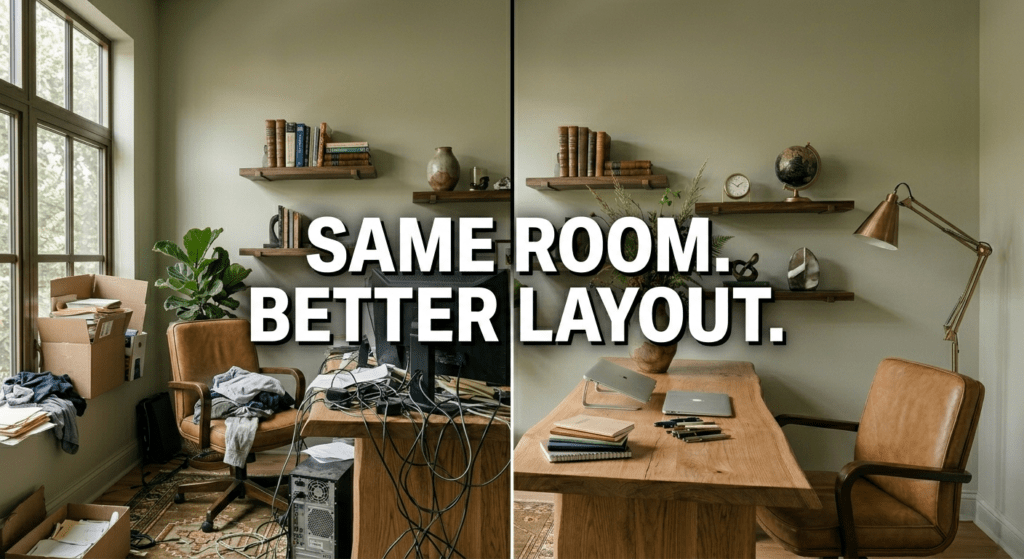
The most noticeable transformation isn’t always visual. It’s psychological.
Before implementing a minimalist setup, many people describe their room as feeling crowded even when it’s clean. Work materials spread into sleeping areas. Charging cables become permanent fixtures. Surfaces slowly accumulate objects until the room feels smaller than it really is.
After simplifying the layout, reducing visible clutter, and creating a dedicated work zone, the room immediately feels more intentional. Walking paths become clearer. Cleaning becomes faster. Video call backgrounds improve. Most importantly, work begins to feel separate from relaxation, even though both happen inside the same room.
The square footage never changes. Your perception of the room does.
Why a Minimalist Small Bedroom Office Works Better
Minimalism is often misunderstood as a purely aesthetic trend. In reality, it solves a practical problem. Small rooms become difficult to use when every surface is occupied and every object competes for attention.
A minimalist workspace removes unnecessary visual information. Instead of constantly processing clutter, your attention stays focused on what matters. This is especially valuable when your bedroom also functions as your office.
The benefits extend beyond appearance:
- Reduced visual stress.
- Faster cleaning and maintenance.
- Improved focus during work sessions.
- Better separation between work and rest.
- More usable floor space.
- Greater flexibility for future upgrades.
When every item has a purpose, the room works harder while feeling calmer. That’s the paradox of good minimalist design: by owning less, you often gain more usable space.
Many projects featured by Architectural Digest demonstrate that restraint often creates a more luxurious appearance than filling a room with additional furniture and decorative objects.
A strong foundation also makes future upgrades easier. Once your desk placement, cable management, and storage systems are working properly, adding better lighting or a larger monitor becomes a seamless improvement rather than another source of clutter.
Frequently Asked Questions
Many people researching small room workspaces are dealing with the same challenges: limited square footage, budget restrictions, and the desire to create a setup that feels professional without turning the entire bedroom into an office. These are some of the most common questions people ask before building an aesthetic minimalist desk setup.
How do you fit a desk and a bed in a 10×10 room?
The most effective solution is placing the bed against the longest wall or pushing it into a corner to free up an uninterrupted wall for the desk. Avoid positioning the desk directly beside the bed if possible. Creating separate zones helps the room feel larger and improves the psychological separation between work and rest. Even in a 100-square-foot room, strategic furniture placement can create a surprisingly functional layout.
What color furniture makes a small bedroom look bigger?
Light-colored furniture generally works best. White, warm ivory, light oak, beige, and soft gray reflect more light and create less visual weight than darker finishes. Matching furniture colors closely to wall colors also reduces contrast, helping the room feel more open and cohesive.
How can I make my cheap desk setup look premium and aesthetic?
Focus on simplicity instead of upgrades. Hide every visible cable, keep the desktop mostly clear, limit the room to a consistent color palette, and avoid unnecessary accessories. A clean, intentional setup often looks more expensive than a cluttered setup filled with premium products.
Is a 10×10 room too small for both a bedroom and an office?
No. A 10×10 room can comfortably support both functions when furniture is scaled appropriately. Compact desks, vertical storage, and thoughtful layout planning allow a bedroom and workspace to coexist without making the room feel overcrowded.
What is the minimum desk depth for a comfortable workspace?
For most people, 18 to 24 inches of desk depth is ideal. This provides enough room for a laptop, monitor, keyboard, and basic accessories while preserving valuable floor space inside a small room.
How can I hide computer cables without drilling into walls?
You can create a nearly invisible cable setup using adhesive cable clips, under-desk trays, Velcro ties, and cable sleeves. Mounting a power strip underneath the desk is often the most effective no-drill solution because it removes the largest source of visible wiring immediately.
The Takeaway: Small Space, Big Focus
Building an aesthetic minimalist desk setup for a small room is not about buying expensive furniture or recreating a picture-perfect social media workspace. It’s about making deliberate decisions that support focus, comfort, and simplicity.
When you position your desk intentionally, hide visual distractions, use vertical storage effectively, and maintain a cohesive color palette, even a 10×10 room can feel significantly larger than it actually is. The goal is not to maximize how much furniture fits inside the room. The goal is to maximize how well the room functions.
A minimalist workspace creates benefits that extend beyond aesthetics. It reduces visual stress, improves productivity, makes cleaning easier, and creates a stronger separation between work and personal life. Those advantages become even more valuable when your bedroom and office share the same four walls.
If you’re continuing to optimize your room, you may also find inspiration in our small bedroom storage and layout ideas, where we explore additional ways to maximize every square foot without sacrificing comfort or style.
The most effective workspace isn’t the one with the biggest budget. It’s the one that helps you focus. With thoughtful design choices and a realistic $150 budget, you can create a setup that feels calm, intentional, and genuinely enjoyable to use every day.