
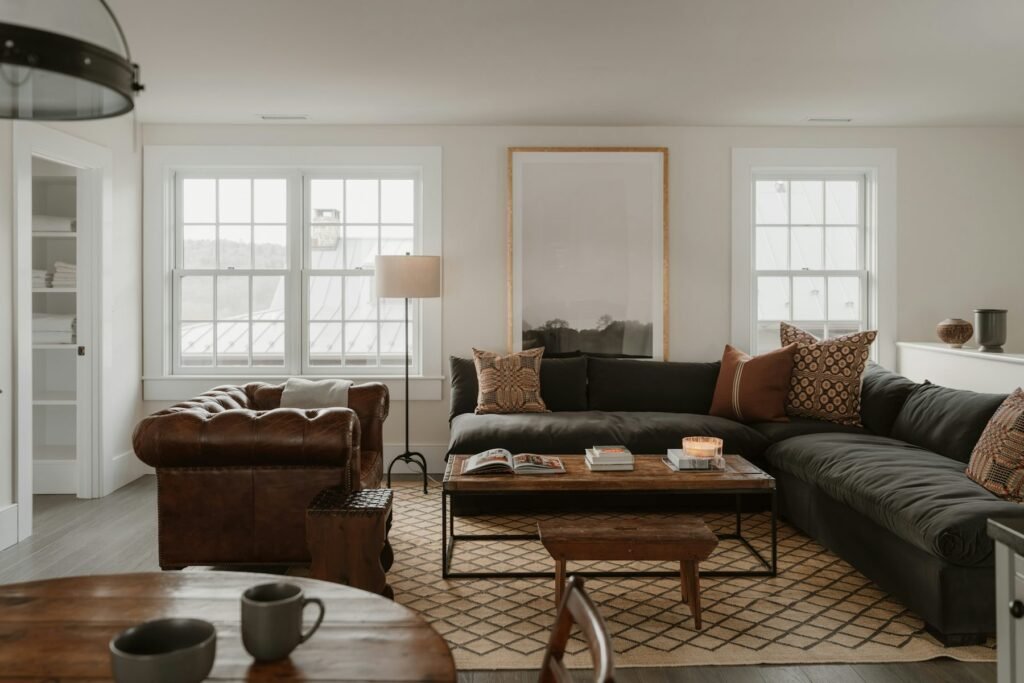
For most living rooms, start with about 14 to 18 inches between the front edge of a sectional and the coffee table. That range gives you useful legroom while keeping drinks, books and the remote within comfortable reach. With an L-shaped sectional, measure the clearance from both seating faces rather than treating the sofa as one straight line.
The Quick Answer: How Far Should a Coffee Table Be From a Sectional?
A practical target is 14 to 18 inches from the edge of the seat cushions to the nearest edge of the coffee table. You can adjust this slightly when the room, table shape or sectional requires it. The goal is enough space to sit down and stand up comfortably without pushing the table so far away that it stops serving the seating group.
This is a furniture-planning guideline, not a universal building-code requirement. In a tight room, a smaller gap may be workable if people can still use the seats and move safely around the table.
Why the 14-to-18-Inch Range Works
The clearance is a compromise between reach and movement. If the table is pushed right against the sofa, knees and legs have little room. If it is moved much farther away, the seating group becomes harder to use because drinks and other items are no longer easy to reach.
There is no single arm-reach measurement that applies to every person, so avoid treating 14 to 18 inches as a precise ergonomic limit. Use it as a starting point, then test the actual furniture arrangement.
Coffee Table Clearance Guide
| Clearance | What It Usually Feels Like | Best Use |
|---|---|---|
| Under 12 in. | Very tight; limited legroom | Only when the room leaves no practical alternative |
| 14–18 in. | Comfortable starting range | Most sofas and sectionals |
| 19–24 in. | More open but less convenient to reach | Larger rooms or furniture that needs extra breathing room |
| Over 24 in. | May feel disconnected from the seating | Use only when the overall layout still works |
The Sectional Challenge: Measuring Around the Chaise
An L-shaped sectional has two seating faces, so the table cannot be positioned correctly by measuring from the main sofa alone.
Keep the Chaise Side Usable
Check the distance from the coffee table to the inside edge of the chaise. Aiming for roughly 14 to 18 inches gives a useful starting point for the gap, but the actual route should be tested with the furniture in place. If that space is the only route around the sectional, you may need more clearance.
Avoid the Corner Dead Zone
A rectangular table can create a sharp corner directly in front of the sectional’s inside angle. If the table is too close to either seating face, the corner can become awkward to navigate.
Round and oval tables reduce hard corners. A soft ottoman can also work well when you want a coffee-table surface and footrest without a sharp edge.
Round vs. Oval vs. Rectangular Coffee Tables
Round
A round table can be useful with an L-shaped sectional because there are no table corners projecting into the walking path. Measure the circle’s widest point when checking clearance.
Oval
An oval keeps a longer usable surface while softening the corners of a rectangular layout. It can be a good middle ground when a round table feels too small.
Rectangular
A rectangular table works well when the seating area is long and the walking routes are straightforward. Keep its corners away from the sectional’s tightest turning points.
Coffee Table Height vs. Sectional Cushion Height
Horizontal clearance is only part of the fit. A useful design starting point is for the coffee table surface to sit at or slightly below the top of the seat cushions. Exact preferences vary, and low-profile tables can work well with deeper sectionals.
Do not assume every sectional has a standard seat height or that every coffee table should be 16 to 18 inches tall. Measure your actual cushion height before buying.
How Far Should a Coffee Table Be From a Chaise?
For the chaise side, start with 14 to 18 inches between the table edge and the nearest usable seating edge. If that gap doubles as a primary walkway, increase it enough to let people pass without turning sideways or catching the table corner.
Also check the chaise’s full extension. A coffee table that looks centered relative to the straight sofa may sit too close to the chaise because the L-shaped footprint changes the available space.
What to Do in a Tight Living Room
Use a Smaller or Narrower Table
Reducing the table’s depth can create the clearance you need without moving the entire seating group. A narrow oval can preserve usable surface area while leaving more room for circulation.
Try a C-Table
A C-table can slide beside or partially over the sofa, moving drinks and small items away from the central walkway. It is especially useful when a full-size coffee table would leave too little clearance.
Use a Soft Ottoman
An upholstered ottoman can provide a forgiving edge and may double as a footrest. If it is used as the main coffee-table surface, use a tray so drinks remain stable.
Move the Surface to the Side
If the sectional already fills most of the room, a side table may solve the problem more effectively than forcing a coffee table into a narrow center gap.
How Big Should a Coffee Table Be for a Sectional?
There is no single length that fits every sectional. As a starting point, a coffee table can be roughly one-half to two-thirds the length of the main sofa section, provided the table still leaves the desired clearance around it.
For a chaise sectional, prioritize the complete seating footprint. A table that is the correct length for the straight sofa can still be too large if it crowds the chaise side.
3 Common Coffee Table Placement Mistakes
1. Measuring From the Sofa Frame Instead of the Seating Edge
Arm and frame thickness can change the usable gap. Measure from the point where a seated person’s legs actually begin, then check the table’s nearest edge.
2. Keeping the Same Gap on Every Side Without Checking Traffic
A 16-inch gap can work between the sofa and table but be too tight if people also need to walk through that space. Give primary traffic routes more room when the layout requires it.
3. Choosing the Table Before Measuring the Sectional
Measure the sectional’s overall width, chaise projection and usable seating edges first. Then tape the proposed table footprint on the floor before buying.
Frequently Asked Questions
How far should a coffee table be from a sectional?
Start with 14 to 18 inches between the front edge of the sectional’s seating area and the coffee table. Adjust the distance for the room’s circulation and the actual furniture dimensions.
How much space do you need between a coffee table and a chaise?
About 14 to 18 inches is a useful starting point. If the gap is also a main walkway, increase it enough for comfortable passage.
Can a coffee table be too close to a sectional?
Yes. A gap under about 12 inches can become uncomfortable for legs and difficult to navigate. In a tight room it may be unavoidable, but test the arrangement before committing to the table.
What height should a coffee table be next to a sectional?
Start with a tabletop that is level with or slightly below the top of the sectional’s seat cushions. Measure the actual cushion height because sectionals vary.
Final Takeaway
For most sectional layouts, 14 to 18 inches is a useful starting clearance between the seating edge and coffee table. With an L-shaped sectional, measure both the main sofa and chaise sides, then give primary walkways additional space when necessary.
If the center of the room is too tight, do not force a large rectangular table into the gap. A narrower oval, round table, C-table or upholstered ottoman can preserve the function of the seating area while improving movement.
For more sectional planning, see What Size Rug Under a Sectional With Chaise? Layout & Sizing Guide. For a broader living-room layout guide, see How to Arrange Furniture in a Small Living Room Without Making It Feel Cramped.